
Hopkins County Active Warrants Explained
Hopkins County publishes no county-wide active-warrant roster. The county's Open Warrants page sends readers to DPS and OmniBase resources, and the inmate vendor runs a live custody and booking feed. Each tool does one job. A person whose own case is in question should call the issuing court and ask whether its process is still active. A record missing from the county website may still sit with a JP, a Municipal Court, the County Court at Law, or a district court. The clerk, not a search page, gives the answer that counts.
Hopkins County Active-Warrant Roster Gap
The official Hopkins County Open Warrants page is a link hub rather than a searchable list. It offers no last-name search and says nothing about covering every court. So the accurate claim is that Hopkins County posts no public county-wide roster, not that no active warrants exist. The Sheriff's contact page gives the local route for service and custody questions, though it publishes no warrant lookup. Use that contact to ask which office handles a specific service or bond issue.
How Hopkins County Tracks Active Warrants
Hopkins County has no single public tracking page, so there is no update schedule to explain. Each issuing court runs its own docket and recall process. The Sheriff serves process and answers custody questions, but the county does not show any public feed covering every JP, municipal, county, and district case. When a clerk confirms a recall or payment, ask two things. Has the court updated its docket, and does it send a separate notice to the Sheriff or another agency? Keep the order or written confirmation, because a third-party page can lag behind what the court has already done. The JP1 page and the County Court at Law page list separate clerk routes in Hopkins County for exactly this kind of follow-up.
Hopkins County Warrant Booking Feed
The current-inmate interface lists arrest date, arresting agency, days in jail, warrant number, count, statute or description, and bond. What it does not do is promise coverage of all unexecuted warrants or state an update cadence. Its rows describe custody, not a county index of open process. That gap matters when you check someone who has not been booked. A missing name on a booking page says almost nothing about a court's unserved warrant. Ask the issuing clerk about status, and ask the Sheriff separately about booking or bond.
Inside an Active Warrant Record
A full record can tie a warrant to a cause, citation, issuing court, charge, bond, service return, and a later recall or quash entry. The booking schema is narrower, often holding only what custody requires. Hopkins County publishes no local warrant-number format.
| Warrant number | Format not published; ask for the identifier and case number. |
|---|---|
| Issuing court | Shows which clerk controls the case and any next setting. |
| Process type | Bench warrant, arrest warrant, capias, or capias pro fine may have different triggers. |
| Status | Confirm active, served, recalled, quashed, or closed with the clerk. |
| Bond or amount | Verify the current amount and accepted route with the Sheriff or court. |
Hopkins County Warrant Status Terms
The words on a docket or booking page mark a stage, not the whole case. A Hopkins County clerk can explain a local code and confirm whether a separate order exists. A payment receipt alone does not mean a warrant has been recalled.
- Active
- Reported as not recalled, served, or otherwise closed; verify with the issuing court.
- Served
- The process was carried out, often by arrest or other authorized service.
- Recalled
- The issuing court withdrew the process.
- Quashed
- A court set the process aside.
- Capias pro fine
- Texas lower-court process tied to fine and cost enforcement after statutory steps.
Most-Wanted Lists and Hopkins County Warrants
A most-wanted list is a curated public-safety selection, never a complete active-warrant index. Hopkins County has no official most-wanted page of its own. The statewide Texas DPS Most Wanted program posts its own notices and tip channels, but it cannot stand in for a local Hopkins County roster. For a fuller explanation of that difference, plus safe tip routes, see the Most Wanted List page, which links to official information without reproducing names or photos. The TMCEC roundup and amnesty article adds statewide court-education context on how these programs work. None of it documents a current Hopkins County event.
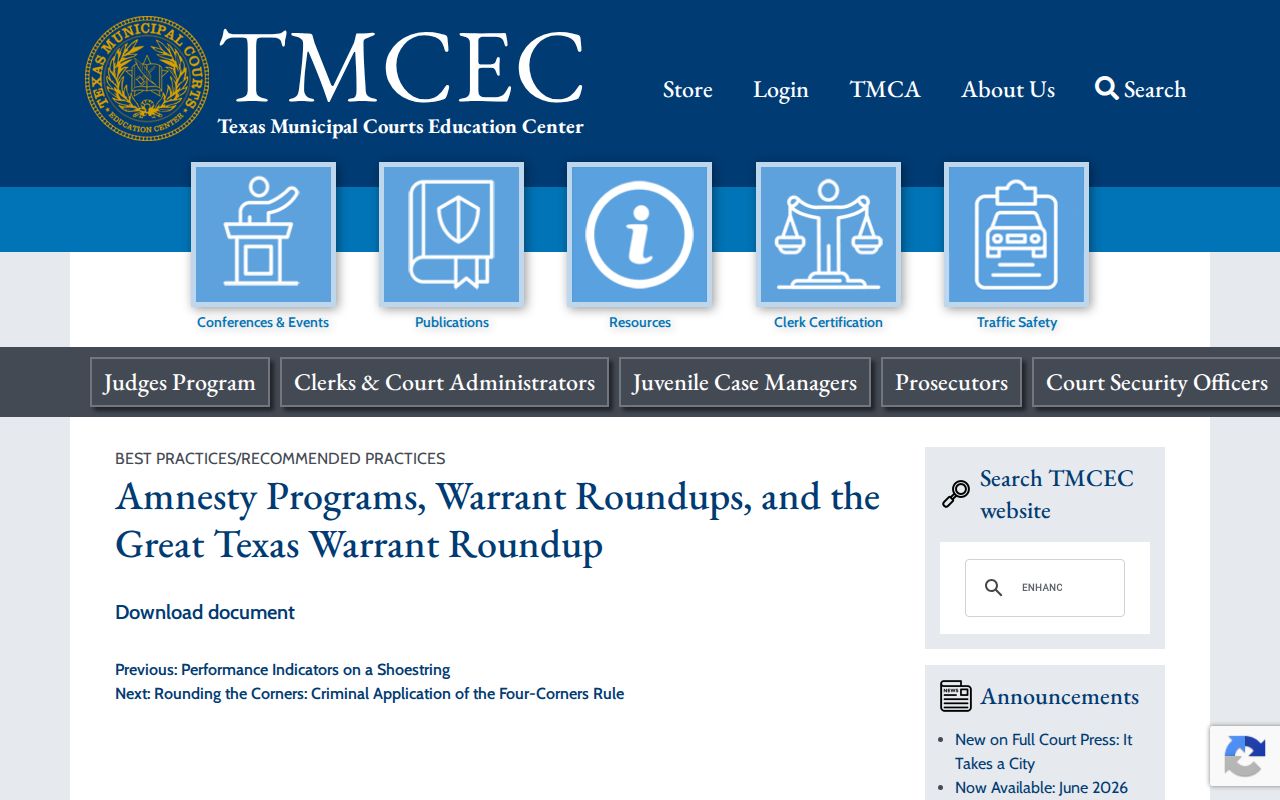
The statewide article describes general municipal roundup practices, and Hopkins County has no current roundup event on record.
Warrant Roundups and Most-Wanted Lists
Hopkins County runs no warrant amnesty week, posts no roundup calendar, and maintains no local most-wanted roster. Statewide program material is not evidence of a county event. If a local notice appears later, confirm the dates, courts included, eligible cases, and required steps with the government source itself. For status, use the court printed on the citation or notice. A roundup article cannot tell whether one person's process is active or whether a payment will recall it.
Your Hopkins County Warrant Listing
First confirm the record is really yours. Ask the source for the court, cause or citation number, warrant type, and current status. If the listing came from a booking feed, call the Hopkins County Sheriff about custody and bond, then reach the issuing clerk about the case and the next setting.
Your Hopkins County Warrant Listing: Do not rely on a single search result alone. Ask the issuing court what step resolves the warrant and what written proof to keep.
For help planning an appearance, speak with a licensed Texas attorney. The county's warrant overview lists the court, clerk, and Sheriff routes across Hopkins County.
Confirm the Hopkins County Court's Current Status
Call the clerk of the Hopkins County court that issued the warrant and ask straight out where things stand. The clerk can pull the court's own docket. You will learn whether the judge has recalled process, scheduled a hearing, or wants payment instead. One answer covers only that court, though, so a second warrant in another Hopkins County court needs its own call. If something changes, ask when the Sheriff or DPS hears about it. Older files usually take a written Texas Public Information Act request, and juvenile, sealed, personal, or active-investigation records can still be withheld or redacted.